Body Compass — Nicole Siegel
When your body
says no.
You've done everything medicine and therapy suggested. Your body still won't cooperate. This course explains why — and gives you the only path to actually enjoying your body again.

Where you are right now
You have tried everything.
Pelvic PT. Therapy. Dilators. Hormonal adjustments. Specialists. Protocols. You may have a diagnosis — possibly several. You have certainly researched yourself into corners at 2am, looking for something that finally explains what's happening in your body and comes with a real way through.
And you are still here. Still in pain, or still numb, or still going through the motions while something in you quietly disappears. Still carrying the thought you don't say out loud: maybe something is just fundamentally wrong with me.
It isn't. And the reason nothing has held is not what you think.
This course lives in the gap.
Not another treatment. A translation.
Every approach you've tried has been aimed at the symptom. Low desire treated as a hormone problem. Pain treated as a muscle problem. Shutdown treated as a past-that-needs-processing problem. And sometimes those things are partially true. But they all share the same fundamental misunderstanding: that your body is doing something wrong.
It isn't. That's why nothing has held.

The reframe that changes everything
Your body is not broken.
It has never been broken.
Your body operates according to the same logic as every living system in nature. It moves toward what nourishes it and away from what depletes it. It contracts when it needs to protect itself. It expands when it feels safe enough to open. It has a pace entirely its own.
When that pace is overridden — by pressure, by performance, by the relentless expectation that you should want more, feel more, be more available — it does the only thing it can do. It says no.
Not because it's broken. Not because desire has gone forever. Because your nervous system is doing its job — scanning for safety, protecting you from what doesn't feel right, waiting for conditions that actually match what your body needs in order to open.
The shutdown, the pain, the numbness, the freeze — none of that is malfunction. It is communication. Your body has a language, and nobody taught you how to read it. Every practitioner you've seen has been trying to fix the signal instead of listening to what it's saying.
This course teaches you to hear that language. And once you can hear it, everything changes.
This isn't a mindset course. It isn't therapy. It isn't sex education. It's a translation — of a language your body has been speaking your whole life, that nobody taught you how to hear.
From the practice
What this work actually does
These are real people. Their presenting symptoms were different. What was the same: every approach they'd tried had been aimed at the symptom, and none of it had reached the thing underneath.
Maya
"Her libido was never the problem. Her body was speaking — in the only language it knew — and it just needed someone who knew how to listen."
Maya came to me because she didn't want sex with her partner anymore. What nobody had accounted for was everything else she was carrying: a new baby, a full-time job, a postpartum period that had been quietly devastating. She was exhausted in a way that went beyond tired. Our first session, we didn't talk about sex at all. We helped her find safety in her own body — something she realized, in that hour, she had never actually felt before.
Partway through our work together, something significant surfaced — a memory her body had been keeping safe for nearly two decades. Rather than breaking her, it became the turning point. For the first time, Maya understood that her body had never been the problem. It had been the most loyal ally she had.
 Dana
Dana
"Her body was never broken. It was protecting her the only way it knew how. Until she learned to protect herself."
Dana had tried literally everything medicine had for a body in pain. Laser therapy. Botox. Numbing cream. Suppositories. Dilators. Years of pelvic floor physical therapy that helped a little, until it didn't. She had been told, in various ways, that her body's job was to show up. That pain was a problem to be solved, not a message to be heard.
What none of it had asked was the question her body had been asking since she was fourteen: What happened that made you decide it wasn't safe to feel pleasure? Her pain wasn't malfunction. It was the most persistent no her system knew how to produce. Once that no had a home — once her nervous system understood it would be respected — the yes started to become possible too.
 Daniel
"The problem was never his body's timing. The problem was that he had never once been in his body at all."
Daniel had read the books. Done the PT, tried the breathing techniques. He'd been told early ejaculation was just how his body worked — that the goal was to manage it, accept it, stop making it mean something. He couldn't stop making it mean something. He was having sex every day and not enjoying any of it. The gap between what he was performing and what he was actually feeling had quietly become the shape of his life.
We didn't fix his ejaculation. We worked with his nervous system — with conscious touch practices, with somatic meditations, with the slow practice of letting his body be felt rather than managed. He started using the word euphoria. That's the end of this story.
Inside the course
What happens in each module
Each module doesn't just teach you something. It moves you somewhere. Here's where you are when you enter, and where you land when you leave.
You get permission to stop treating yourself like a problem
Before anything else, you want one thing: to stop feeling like you're the problem. Not a better technique. Not another specialist. Just to stop waking up already in debt to your own body. The welcome does something quiet and significant — it gives you a new frame before a single lesson begins. You go find a green living thing. A plant, a tree, something that's alive. And you watch it. That's the instruction. What you're actually doing is practicing the only thing this whole course asks of you: treating your body the way you'd treat something that knows exactly what it's doing.
You finally understand why you're not broken
You want to stop feeling broken. That's the thing underneath all the research, all the appointments, all the trying. Not a better diagnosis — permission to stop believing the story that something is fundamentally wrong with you. That's what this module gives you. Not as reassurance, but as evidence. You'll understand, specifically and usably, why your body has been doing exactly what any living system does when it hasn't been heard — and that understanding lands differently than being told "you're fine." You leave here with the shame loosened. With the exhaustion of fighting your own body starting, for the first time, to lift.
You find out why desire stopped showing up — and what it actually needs
You want to stop dreading it. Not even to want it the way you used to — just to stop feeling the weight descend when you know it's coming. The quiet calculation. The performance of presence you don't feel. Sex has become something you endure, and you are so tired of that being the shape of intimacy in your life. This module is where you find out why. Not because something is wrong with you — because you've been trying to produce pleasure the way you'd produce a work deliverable. On schedule, on demand, by force of will. Your body doesn't work that way. No body does. You leave this module understanding what desire actually needs to exist — and it is nothing like what you've been trying to give it.
You get the real information nobody gave you
You want someone to actually give you real information. Not another referral. Not "try to relax." Not a pamphlet. Specific, honest, usable knowledge about what is happening in your body and what would actually help. This module is that — and it goes further than anything you've been handed in a clinical setting. You'll learn why dilators so often make vaginismus worse instead of better. Why numbing creams work against you. What the 45-minute arousal sequence is, and why almost no one knows about it, and why knowing changes everything about how you understand penetration pain. You'll get the anatomy reference, the pelvic floor model, the scar tissue work. And you'll get the language scripts — the actual words — that let you walk into any appointment and participate rather than surrender. You leave here feeling capable. Like someone who finally has the information they were owed years ago.
You leave with something that keeps working after the course ends
You want to know there's a path you can actually trust. Not hope — a method. Something that doesn't depend on willpower or the right mood or everything going perfectly. Something that works with how your body actually changes, not how you wish it would. The Principles of Pleasure™ give you that. Six principles that describe how any living system opens, closes, paces itself, and thrives — including yours. Once you have them, you're not dependent on the course anymore. You have a framework that reads your own body's signals back to you, for the rest of your life, in whatever season you're in. The 1% Rule tells you what change actually looks like in a nervous system: slow, specific, survivable. Small enough that your body doesn't register it as a threat. Permanent in a way that dramatic overhauls never are. You leave here not just finished with a course. You leave with something that keeps working.
Everything you get
inside this course
Here's what's included — and what each piece is actually worth.
Your body will tell you how fast to go.
Is this the right fit?
Who this is — and isn't — for
You've probably wondered, somewhere in the middle of all of it, whether there's even anything out there made for a situation like yours. There is. This course was built for exactly the person who has tried everything and still isn't better. That said, it isn't for everyone.
This is for you if
- You've been told something is wrong with your body, and part of you has started to believe it
- You've tried therapy, pelvic PT, the conversations — and nothing has reached the root of it
- Sex feels heavy, obligatory, or simply gone — and you're exhausted from performing
- You want to understand what your body is actually communicating, not just manage the symptoms
- You're ready to approach your body with curiosity instead of frustration
- You want something experiential — not another framework to think your way through
- You're a partner wanting to understand what's happening in a body different from your own
This is not for you if
- You're looking for techniques or a step-by-step fix
- You want a purely clinical explanation of sexual function
- You're not willing to slow down and actually feel what comes up
- You're in acute crisis and need immediate therapeutic support — please seek that first
- You're looking for a couples course — see Reset Your Erotic Rhythm for that

Who created this
I'm Nicole Siegel
I'm a Certified Sexological Bodyworker® and trauma-informed somatic practitioner. For years I worked exclusively in intensive 1:1 practice — sitting with people whose bodies had been told, in every language medicine and culture knows, that something was wrong with them.
None of them were broken. Not one. What I found, over and over, was that every symptom had a logic — a body doing exactly what a living system does when it hasn't been listened to.
The Body Compass Method™ grew out of that observation. My client split is roughly 50/50 across male and female bodies — unusual in this field, and why this course covers both.
This course is the translation key I wish every one of my clients had found before they spent years in approaches that were looking in the wrong place.
Included — The DSM-X Guide
Have you been given a diagnosis
that explained nothing?
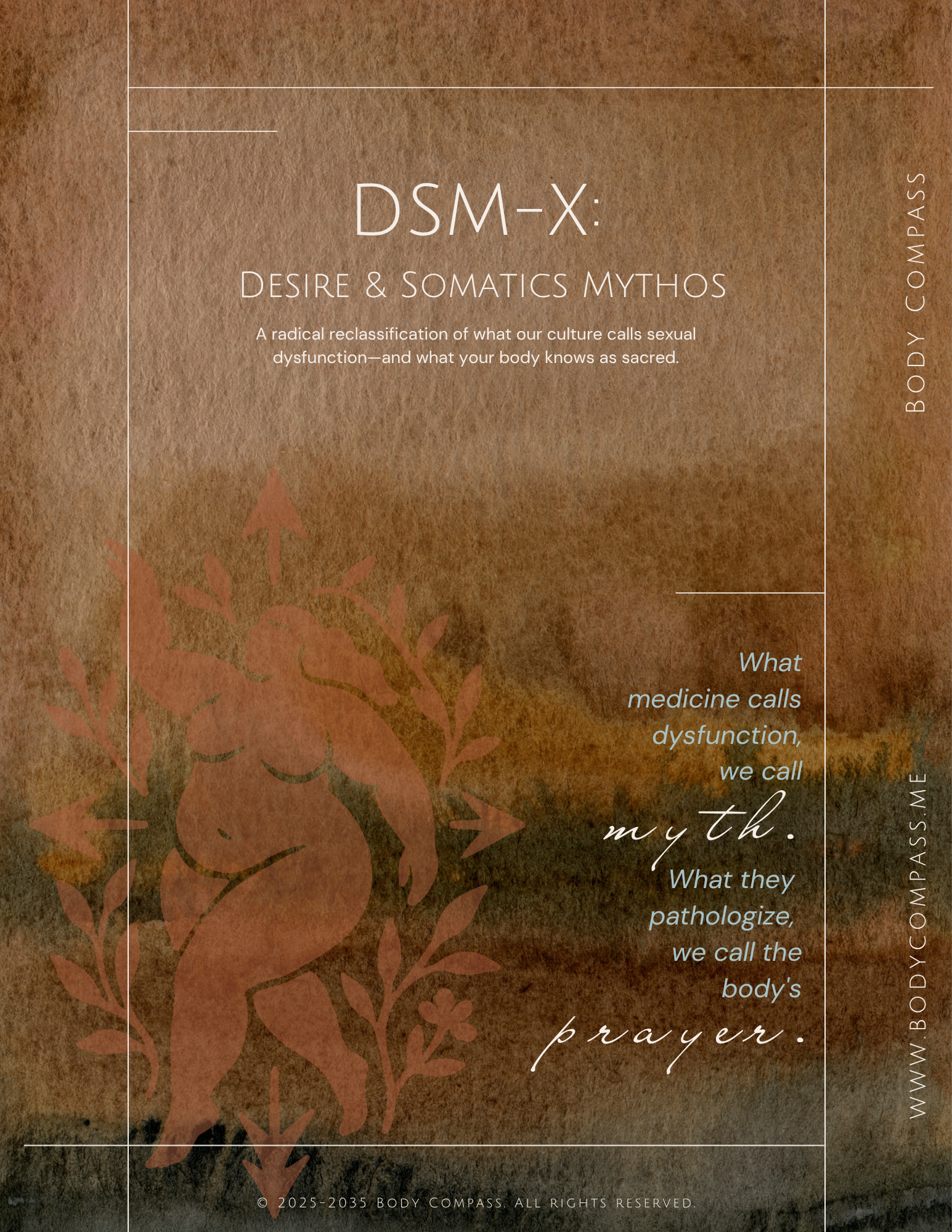
Hypoactive Sexual Desire Disorder. Vaginismus. Genito-Pelvic Pain Disorder. Erectile Dysfunction. Delayed Ejaculation. Female Sexual Arousal Disorder. These labels describe what your body is doing. They say nothing about why — and they say even less about what it would take for things to actually change.
Low / absent desire
Your body protecting its energy for what actually nourishes it
Painful sex
A no that had nowhere else to go
Erectile difficulty
A nervous system that doesn't feel safe enough yet
Inability to orgasm
A capacity container that hasn't been nourished enough to expand
Shutdown / numbness
The most intelligent protection your system knows
Delayed ejaculation
A body that doesn't yet trust the pace it's being asked to move at
The DSM-X is a 100+ page companion guide included with this course. It goes symptom by symptom — translating every common sexual diagnosis through the Body Compass Method™, so that what you've been told is wrong with you finally starts to make a different kind of sense. This is a reference you'll return to long after the course is finished.
Questions
What people ask before enrolling
I've tried everything. Why would this be any different?
Because everything you've tried addressed the symptom. This addresses the layer underneath — the nervous system's threat assessment. That's why nothing has held. Dilators, PT, talk therapy, even pelvic Botox — all of them are working on the signal without asking what the signal is communicating. This course does the thing none of those approaches did: it asks.
This sounds a bit woo. Is it evidence-based?
The sphincter physiology, the 45-minute arousal timeline, the nervous system research — all of it is grounded in science. The metaphors (green things, forests, tides) are in service of embodied understanding, not mysticism. Nicole's credential as a Certified Sexological Bodyworker® is a rigorous somatic training, not a wellness certificate. The language is earthy because that's what the body responds to — not because the science isn't there.
I just need to fix the physical problem. How is this relevant?
The physical problem persists because the nervous system layer hasn't changed. The vaginal opening is a sphincter governed by the autonomic nervous system — it opens when the body feels safe, closes when it doesn't, automatically, without consulting your conscious will. Treating vaginismus or pelvic floor dysfunction without addressing the threat assessment is like trying to open a door that is locked from the inside. This course works on the lock.
I don't have time for a full course right now.
There is no right pace. One lesson a week is enough. The 1% Rule — that the nervous system changes through the patient accumulation of small, survivable experiences of something different — is the entire philosophy of this course. A 1% shift is not a compromise. It is the actual mechanism of change.
Is this for my body specifically? I have [vaginismus / low libido / ED / early ejaculation…]
The course covers bodies with vaginas (vaginismus, dyspareunia, low libido, pelvic pain, shutdown, numbness) and bodies with penises (erectile difficulty, early ejaculation, pelvic floor dysfunction, performance anxiety). Partners of people experiencing any of the above are specifically welcome — understanding what's happening in a body different from your own changes the dynamic entirely. The male body track is in development and will be added at no extra cost.
My partner is the problem, not me.
That may be partly true. And what you'll find is that when you change your relationship with your own body — when you have language for what you want, a real no that comes from inside you rather than performed compliance — the relational dynamic shifts. Not because your partner changed, but because you have. Partners are welcome to take this course alongside you.
$197 feels like a lot when I've already spent so much.
Every specialist appointment, every failed protocol costs more — in money, time, and the toll of trying something that doesn't address the actual layer. This course is the nervous system work that makes every other treatment you've done more effective. That is worth considerably more than $197.
What if it doesn't work for me?
In years of practice, Nicole has never met a body that couldn't find its way back to pleasure. The capacity is always there. What varies is how long it takes, and what conditions need to be in place. This course creates those conditions. If you want more direct support after completing it, 1:1 work with Nicole is available as the next layer.

When Your Body
Says No
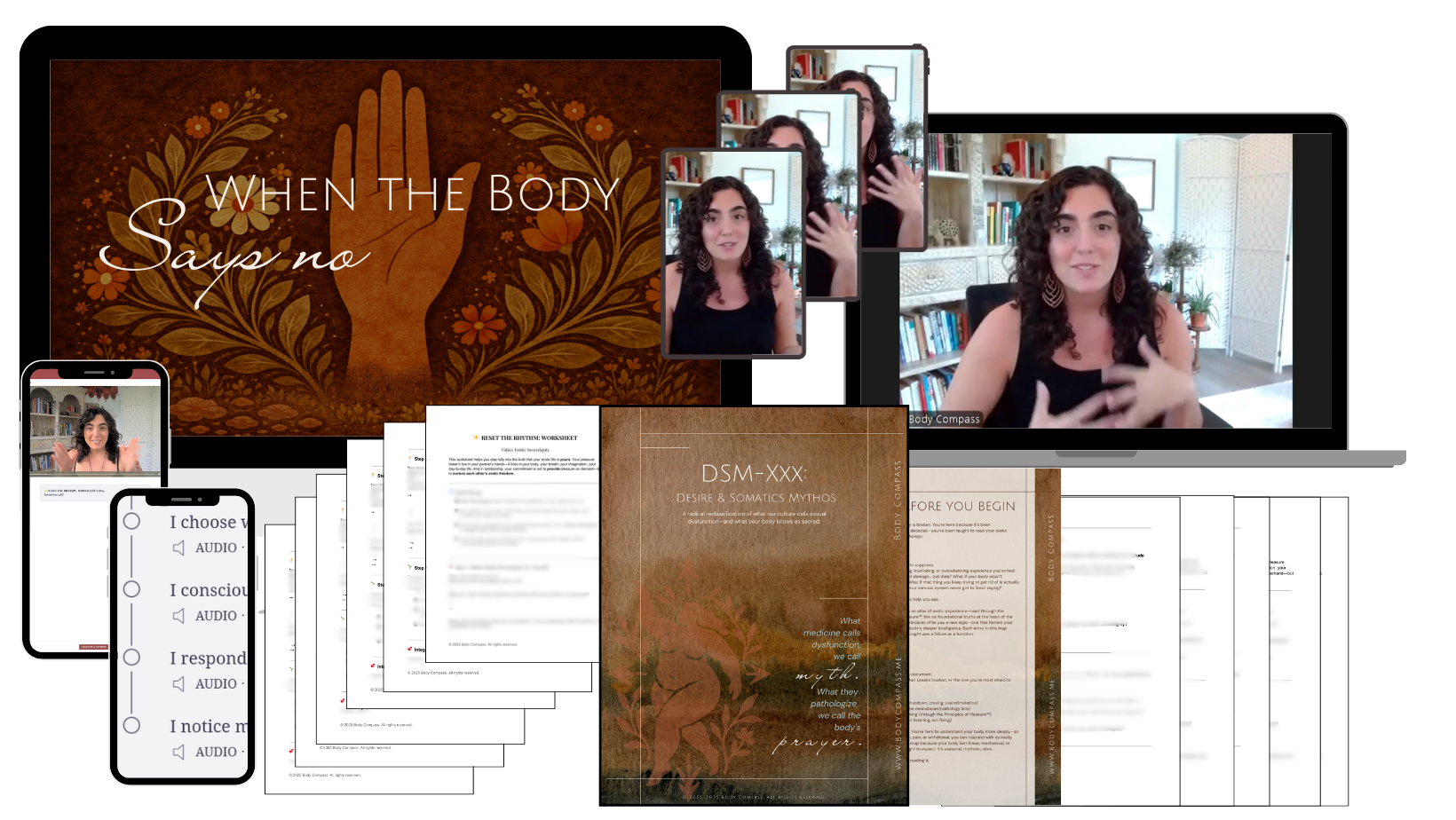
- 16 video lessons — self-paced, lifetime access
- 6 somatic audio practices
- The DSM-X — 100+ page companion guide
- Treatment Companion Workbook
- Male body track — coming soon, included
One payment — no subscription — yours to keep and return to
Begin the Course NowImmediate access · Move at your own pace · Your body will tell you how fast to go