


If you’ve ever thought:
“Why am I not attracted to him anymore?”
“Why do I feel like the grown-up in this relationship?”
“Why do I want him… but also feel exhausted by him?”
Your body did not randomly stop wanting him.
And this is NOT about communicating better or trying harder.
You’re not broken, and the only solution is not divorce.
There is a predictable relational pattern that quietly shuts down desire — even in loving relationships.
And once you see it, you can’t unsee it.Reset your
Er.o.ticRhythm
Attraction doesn’t disappear randomly. It disappears when you become his emotional manager.
When you track the feelings.
Initiate the repair.
Carry the growth…
You quietly lose desire while doing it.
Reset Your E.ro.tic Rhythm is an 8-week live intervention that interrupts this pattern at the root — without asking you to do more.
It separates responsibility.
It makes over-functioning completely unnecessary.
For couples trapped in the dynamic now and
single women who are done recreating it in their relationships.
We begin February 23rd, 2026

When You’re No Longer the Emotional Infrastructure…
You stop feeling like the only emotional adult in the relationship.
He stops feeling behind, confused, or inadequate.
You no longer coach him into basic relational skills.
Desire returns when you’re no longer in the teacher role.
Partnership starts to feel mutual instead of managerial.
“I‘ve been wanting him to meet me desperately for years. I honestly didn’t think it was possible until this course. We both changed so much in such a short amount of time. I highly recommend this to any woman who is in love with a (slightly) immature or just a well-intentioned guy who just keeps missing the mark.”
— S, former participantLet me be super honest for a sec..and if you’re not a video girly—keep scrolling (relief is waiting for you below)
The exact Pattern That Flattens Attraction

The Emotional Over-functioning Pattern is the dynamic most couples don’t have language for—until it’s already flattened desire.
It usually looks like this:
One partner becomes the emotional engine of the relationship
She tracks the health of the connection, initiates repair, and holds the relational memory
He may genuinely want to do the right thing—but feels perpetually behind, confused, or like he’s always getting it wrong
Over time, he stops initiating because nothing seems to land anyway
She steps in more because someone has to
The relationship becomes functional, but not er0t.ic
On her side, the body makes a very rational call:
If I have to lead you, I can’t want you.
On his side, the experience is often quieter but just as stuck:
He feels like the rules keep changing.
He tries, misses the mark, retreats.
And eventually, he disengages—not because he doesn’t care, but because he doesn’t know how to succeed here.
And if you’re single, you may recognize this pattern by looking back —
noticing how past relationships slowly asked you to become the translator, the teacher, the one who “did relationships” for two.
Reset Your Er0ti.c Rhythm exists for women who are ready to choose something different moving forward.
other Women who recognized themselves in the exact spot you’re in right now:
Created by Nicole Siegel, Certified S.e.xological Bodyworker®
After working with hundreds of couples inside this exact dynamic,
one pattern became clear:
Insight wasn’t the problem.
The pattern was.

Why this matters nowThe longer a relational dynamic runs, the more your nervous system adapts to it.
Attraction doesn’t usually return on its own.
It adapts to structure.
If nothing changes structurally,
your body will keep making the same rational call (distance + shut down + visceral ‘no’).
This is not about trying harder.
It’s about interrupting the pattern before it settles in for good.

Why insight, therapy, and good intentions often stall here
Most couples who arrive at this pattern are not uninformed.
They’ve talked. They’ve reflected. Many have been in therapy for years.
The stall happens for a few specific reasons:
Insight doesn’t change roles.
Understanding the dynamic doesn’t automatically reorganize who leads, who tracks, and who carries responsibility in the relationship.Talking often reinforces the imbalance.
When one partner already has more emotional language, conversations tend to keep positioning her as the guide—and him as the one being guided.Good intentions aren’t structure.
Wanting to do better doesn’t tell a nervous system how to do better in real time.Therapy prioritizes understanding over re-patterning.
That can be deeply valuable—but in this specific dynamic, it can unintentionally keep the same roles intact.
Over time, couples end up with a lot of awareness…
and very little change.
Not because they’re failing—
but because this pattern requires an intervention that works at the level of structure and embodiment, not explanation alone.
Why Reset Your Er0tic Rhythm works
Reset Your Er0tic Rhythm was designed specifically for this pattern — not as a mindset shift, but as a structural reorganization of the relationship.
It works because it changes how responsibility, learning, and leadership move through the system.
1. Men are taught directly
In RYER, men are not coached through their partner.
They receive clear instruction, orientation, and expectations without her translating, managing, or carrying the emotional frame.
This alone interrupts the over-functioning loop.
Responsibility can only redistribute when learning does not pass through her first.
2. Separate portals prevent emotional spillover
Each partner works inside a container designed for their role in the pattern.
That means:
No cross-processing
No “did you listen to your audio?”
No emotional labor leakage
She is not responsible for his growth.
He is not performing growth for her.
This separation restores polarity before any e.r0tic work even begins.
3. Structure replaces effort
RYER is paced, contained, and time-bound for a reason.
Growth here does not rely on:
motivation
mood
emotional bandwidth
or having the “right” conversation at the right time
The structure does the work.
When the nervous system knows:
where it is
what’s expected
and when it ends
it can finally relax enough for change to occur.
4. Embodiment comes before insight
RYER prioritizes doing before explaining.
Practices are designed to:
interrupt old responses in real time
create new bodily experiences of leadership, receptivity, and responsiveness
allow the relationship to feel different before it’s fully understood
This is how patterns actually shift — not through better language, but through repeated embodied evidence that something else is now possible.
5. The intervention is finite
RYER is not an open-ended container.
It has:
a clear beginning
a defined arc
and a deliberate completion
This matters.
Endlessness keeps systems suspended.
Completion allows integration.
“This class is exactly what I was longing for. It gave me the language and tools to honor what I have been feeling inside for so long and did not know how to express. I felt completely seen and understood. I loved the first three weeks of learning separately because I could release any responsibility for his learning and just showed up with what I was learning.”
For many couples, this has been the missing piece:

You were never meant to be the emotional infrastructure of the relationship.

What changes when the pattern shifts
When emotional over-functioning stops being the organizing principle of the relationship, change doesn’t arrive as a big dramatic moment.
It shows up as relief, simplicity, and ease.
For her
The urge to manage, explain, or “fix” softens
Desire becomes available again because leadership has redistributed
Her sensual energy no longer has to compete with responsibility
Not because she tried harder — but because the system finally stopped requiring her to.
For him
Expectations become clear instead of implied
He knows what leadership looks like in practice, not theory
Confidence replaces defensiveness or withdrawal
Initiative becomes possible because the rules stop shifting
He can meet her without feeling like he’s always getting it wrong
Not because he was pressured — but because he was given a structure where success is possible.
For the relationship
Polarity reorganizes naturally
Conversations get simpler because less is at stake
Repair happens faster, without emotional spirals
Attraction & s3x stops depending on vigilance, tracking, effort
The relationship no longer runs on one nervous system doing all the work.
For single women
The shift often happens earlier.
You recognize the pattern before it locks in:
before you become the teacher
before you become the translator
before desire quietly drains away
RYER gives you a felt sense of what not to carry — and what to look for instead.
How the program is structured
Reset Your Er0ti/c Rhythm is an 8-week structured intervention.
By intervention, we mean stepping in before emotional over-functioning becomes the organizing principle of the relationship, or to stop it in it’s tracks completely.
Rather than asking you to communicate better or try harder, the program temporarily replaces the old relational rhythm with a new one — so your bodies can experience something different.
The program moves in a clear, steady rhythm.
You don’t have to decide what to focus on or when to do it.
The path is already laid out — so you can soften and follow it.
This structure exists for one reason:
to take pressure off the relationship, not add more.

How will this be different than everything else we’ve tried?
RYER is different because it doesn’t try to repair the relationship by bringing the two of you into more conversation together.
Most relational transformation works by putting the dynamic on the table and asking you to talk about it, negotiate it, or emotionally process it as a couple.
RYER does the opposite. It separates the work at first, removes real-time relational pressure, and changes the pattern through asynchronous, embodied guidance that doesn’t require agreement, timing, or emotional availability from both people at once. That separation is what allows the system to reorganize without spirals, defensiveness, or you having to hold the emotional center — which is why it often succeeds where joint processing stalls.
Is this going to take pressure off me — or add more?
This program works because you’re no longer the one holding the process.
Weekly pacing prevents overwhelm and avoidance
Clear expectations reduce power struggles
Defined roles stop emotional labor from leaking back to her
Time-boundedness allows the nervous system to commit fully
When people know:
where they are in the process
what’s expected of them
and when it ends
they can stop bracing — and actually engage.
No.
This program is designed so you are not the one holding it together.
You are not responsible for:
tracking his progress
reminding him to engage
translating the work
or keeping the momentum alive
That is what the structure is for.
Is this another thing I have to manage?
🤍Inviting Him InIf you’re reading this and already feeling that familiar tightness —
How do I bring this to him without it becoming another thing I have to manage? — I want you to pause.
I see you.
That moment matters. And it’s often where women quietly take on more responsibility before the work has even begun.
That’s why I created a short, simple overview (linked below) you can share with him — written specifically so you don’t have to explain, translate, or carry the emotional frame.
It describes what RYER actually is, how it works, and why it’s different — in language that he can hear without defensiveness or shame.
You can send it as-is.
You don’t need to soften it.
You don’t need to get the timing perfect.
Just offering the invitation is enough.
👉 [Download: A Simple Overview to Share With Your Partner]
If he’s open, you step into this together.
If he needs time, the work still begins — because this program changes the whole dynamic, not any single person.
Who this program is for
RYER is for you if:
You’re the one who notices when something feels off
You’re the one who initiates the conversation, the repair, the “check-in”
You carry the relationship in the background of your mind, even when things are “fine”
You want closeness, but find your desire flattening the more responsibility you carry
You love your partner, but don’t want to keep leading him into intimacy
You may not think of yourself as “over-functioning.” You may just feel tired.
Tired of being the one who keeps things moving. Tired of being the emotional translator. Tired of wanting to be met instead of managing.
RYER is not for you if you want to:
manage or monitor another person’s growth
control outcomes through effort or persuasion
keep carrying the relational load while hoping it eventually pays off
RYER does not require you to make your partner participate, comply, or “get it.”
What it changes is your position in the dynamic — so responsibility no longer lives in your nervous system.
There is a clear process inside the program for inviting a partner into the work without over-functioning — and for continuing the work even if they choose not to engage.
Your work here is not contingent on anyone else’s readiness.
if you’re single, this program could transform every relationship in your future
If your past relationships tend to follow a familiar arc:
You start out curious, open, engaged
Somewhere along the way, you become the one doing more of the emotional work
You feel yourself explaining, accommodating, holding things together
Desire fades — not because you stopped caring, but because you started carrying
The relationship ends, and only later do you see the pattern clearly
Reset Your E. Rhythm will help you feel this dynamic in your body —
so you don’t have to wait until hindsight to recognize it again.
It teaches you what mutual leadership, polarity, and responsibility actually feel like —
so you can notice the moment a relationship starts asking you to over-function.
Imagine if your relationship no longer depended on you noticing, initiating, or holding everything together.
How the work unfolds
The heart of the program: daily audio transmissions
At the center of RYER are short, intimate audio teachings, about seven minutes a day.
Monday through Friday each partner receives their own audio guidance, listened to privately — not to be dissected, discussed, or turned into another relationship task.
These audios aren’t asking you to figure anything out.
Instead, they:
gently orient your body toward safety and clarity
loosen the familiar reflexes that keep you over-responsible
and begin restoring a sense of mutual rhythm, responsiveness, and desire
You listen.
You go on with your day.
And over time, the relationship starts to feel different — without effort or force.
This isn’t homework or something you have to stay on top of.
It’s a soft, consistent rhythm that works in the background of your life —
supporting change while you live, rest, work, and love.
why this actually works
Most relationship work asks you to lean forward — to pay attention, to process, to fix, to hold.
This work asks something else.
It invites you to let yourself be held by a structure that knows where you’re going —
so you don’t have to keep steering.
And from that place, something genuinely new becomes possible.
Weekly live calls for 8 weeks
Shared space, real support, and being met in community
Alongside the daily audio guidance, Reset Your E. Rhythm includes live, facilitated calls that offer something many people don’t realize they’ve been missing:
being in a space with others who are working on the same exact relational pattern — intentionally, consciously, and without shame.
For many women, this is one of the most relieving parts of the program.
Not because you’re asked to share more —
but because you’re no longer alone in something that often feels isolating everywhere else.
the magic of being held in communtiy
Most of us are trying to live into a new paradigm of love without many models for what that actually looks like.
We’re unlearning inherited relationship roles & norms.
We’re questioning dynamics that were normalized for generations.
And we’re doing it inside a culture that often reflects back confusion, resignation, or blame.
Being in community with others who are also doing this work matters so so much.
It reminds your nervous system:
you’re not imagining the problem
you’re not asking for too much
and you’re not alone in wanting something different
There is a quiet but powerful kind of generational healing that happens when people gather around a shared intention to do relationships differently — not perfectly, but consciously.
How the calls are structured
The live calls are intentionally separated, just like the audio tracks.
From weeks 1–4:
Women attend women’s calls
Men attend men’s calls
These calls support each person in understanding their role in the pattern —
without cross-talk, performance, or emotional spillover.
From weeks 5–6:
Couples calls are introduced, where shared integration becomes possible from a more grounded place
For my single ladies:
attend the women’s calls throughout the program
do not attend the couples calls
This structure ensures that no one is asked to carry, translate, or manage the work for someone else.
On these calls, people often experience:
relief at being understood without having to explain
resonance in hearing others name what they’ve never had language for
a softening of shame around patterns they thought were “just them”
and a sense of steadiness that comes from being held in something larger than their individual relationship
You’re not required to speak. You’re not expected to perform insight. You’re free to listen, receive, and let the work keep settling.
Many women describe these calls as the place where they realize:
“I don’t have to hold this alone anymore.”
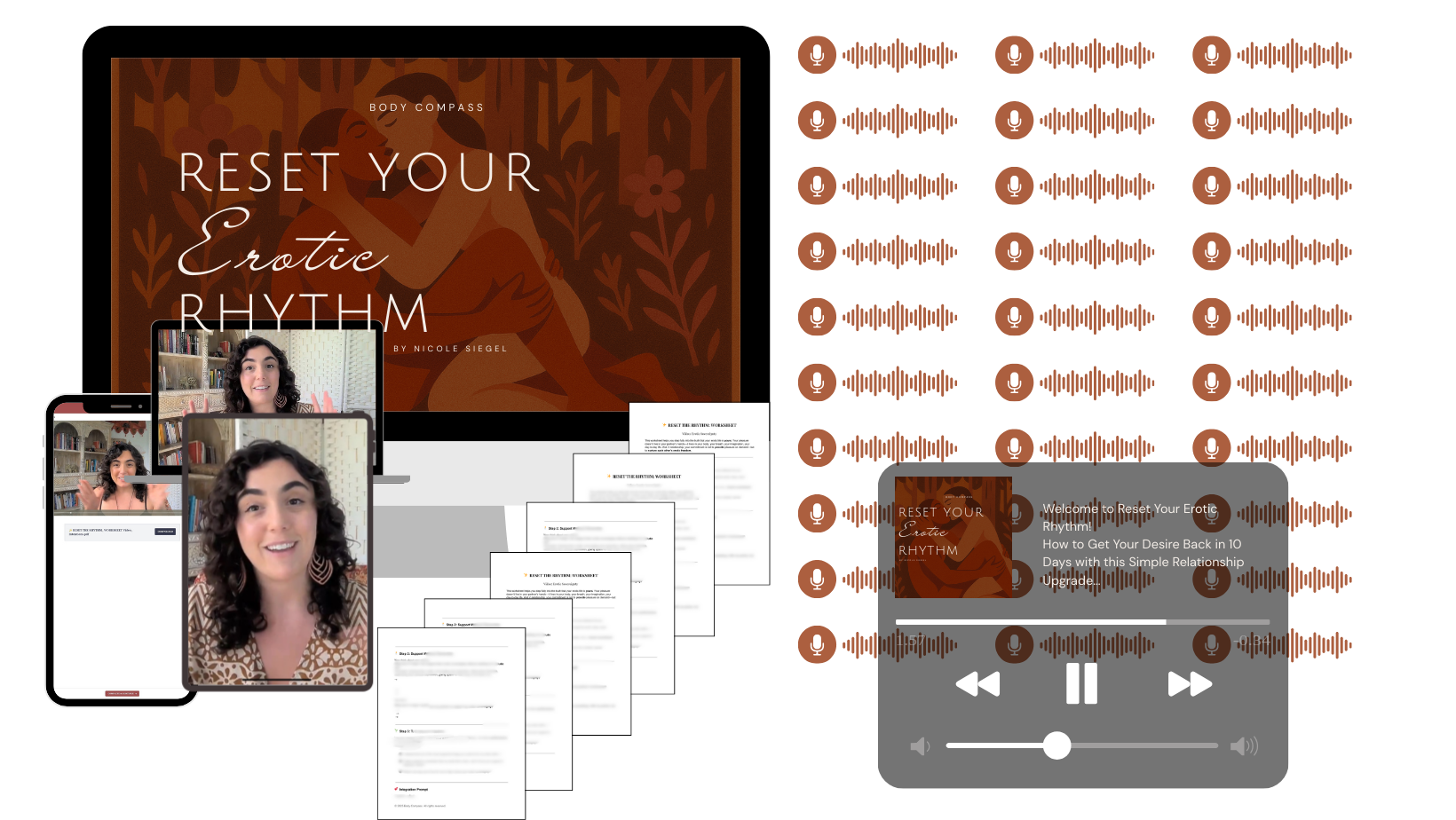
When you join Reset Your Er0t1c Rhythm, you receive:




When you enroll…
You’ll receive immediate access to orientation materials and next steps so you can settle into the rhythm of the program before it begins.
Once the course begins, your enrollment includes:
Access to the full live 8-week program (2 zoom calls a week) / 5-week program for single women (1 zoom call a week)
Short, intimate recorded daily audio guidance (7-25 minutes a day)
Separate tracks for women and men, designed to interrupt emotional over-functioning (essentially 3 courses in 1)
Live women’s calls and men’s calls during the first phase of the program
Live couples calls during the later integration phase
A supportive community of others working with the same relational pattern
A facilitated process for inviting a partner into the work without over-functioning
What it felt like to say yes…
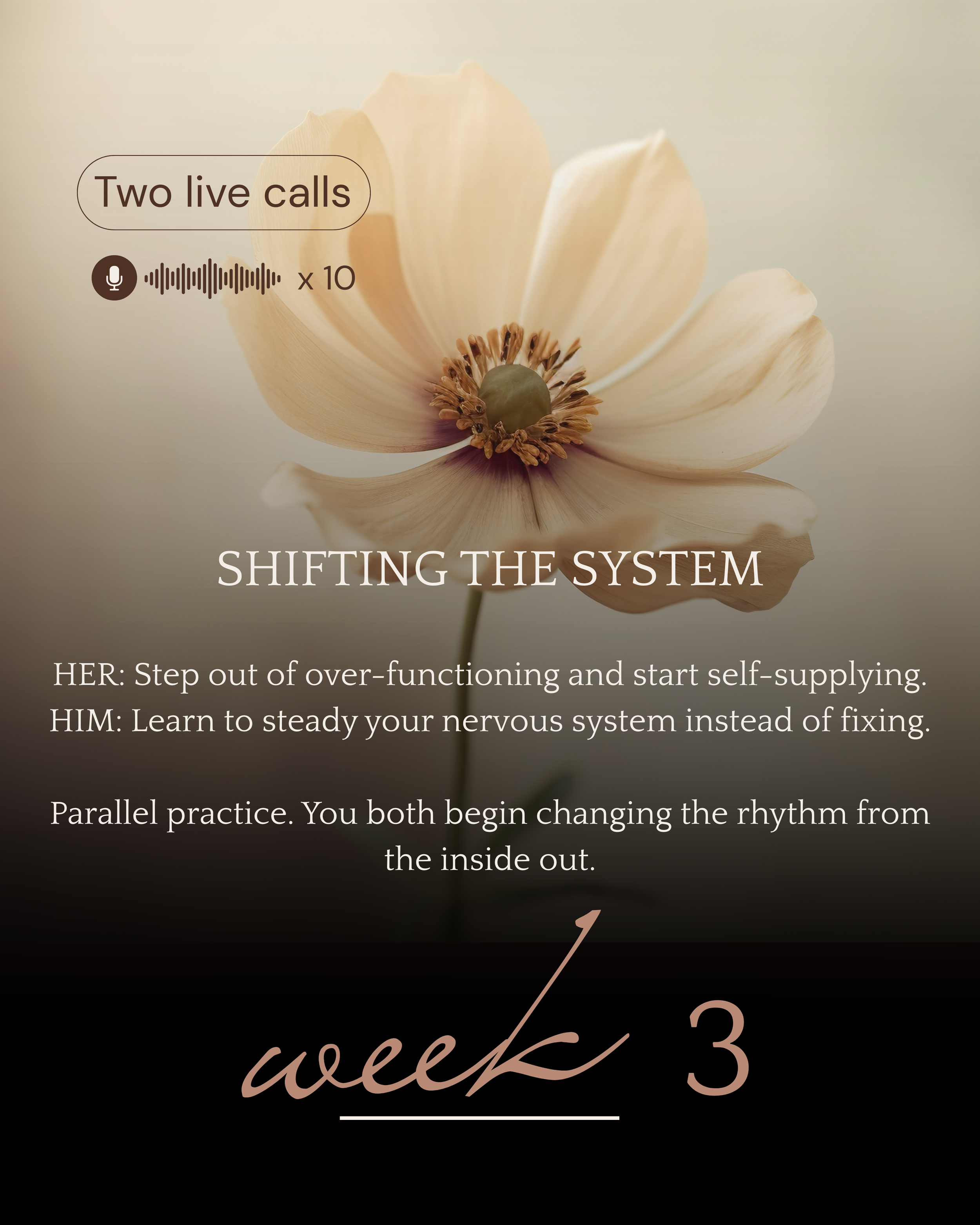
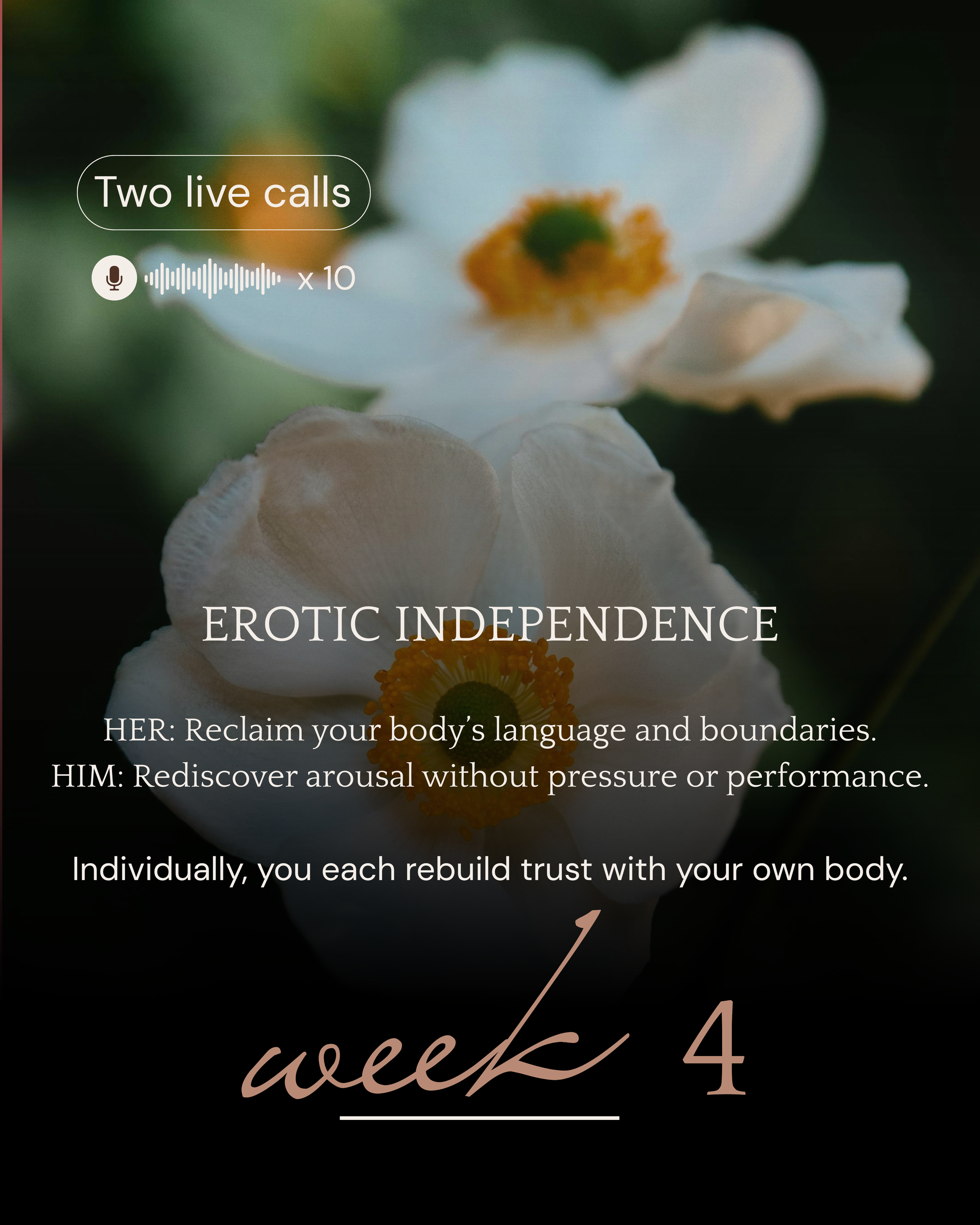
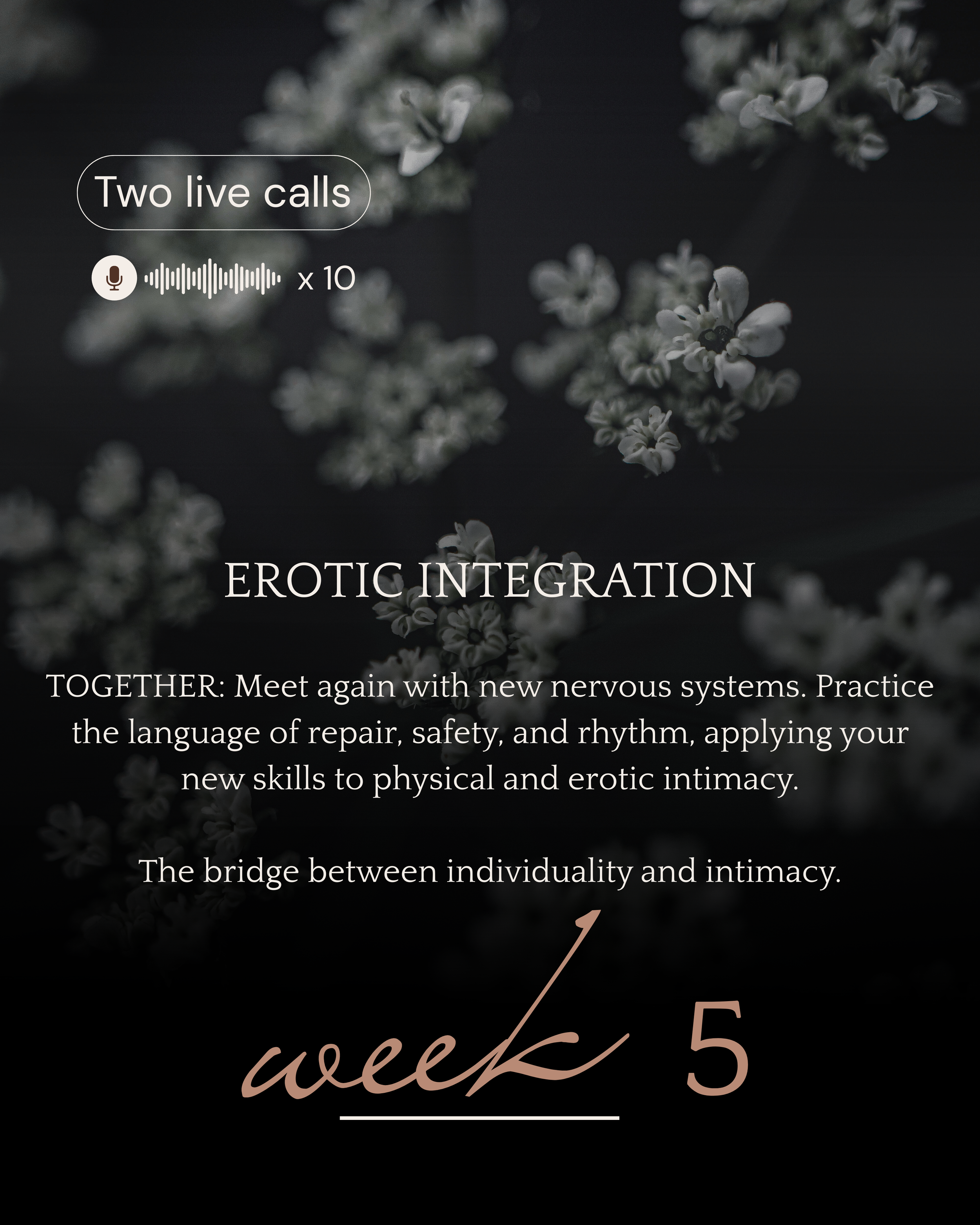
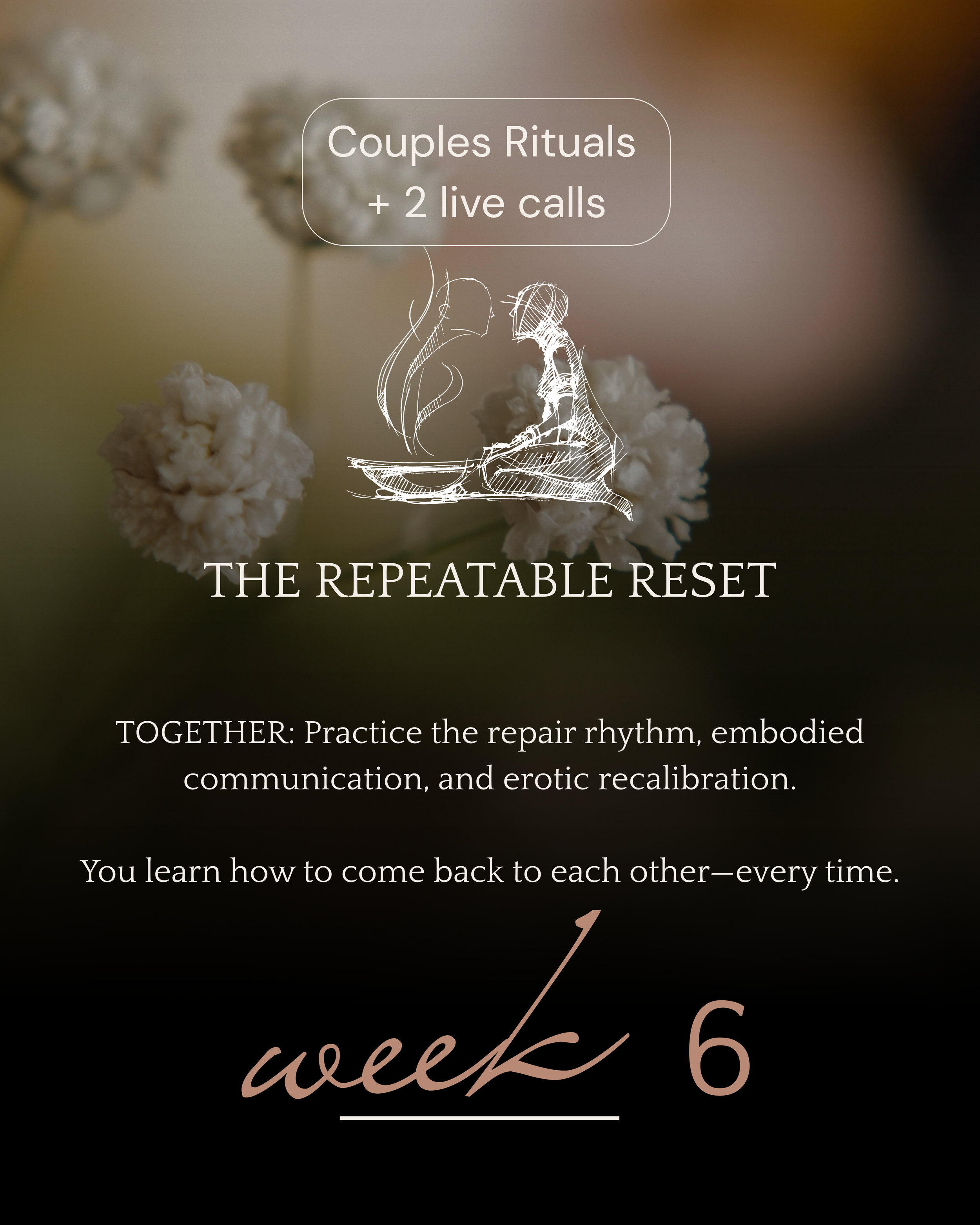
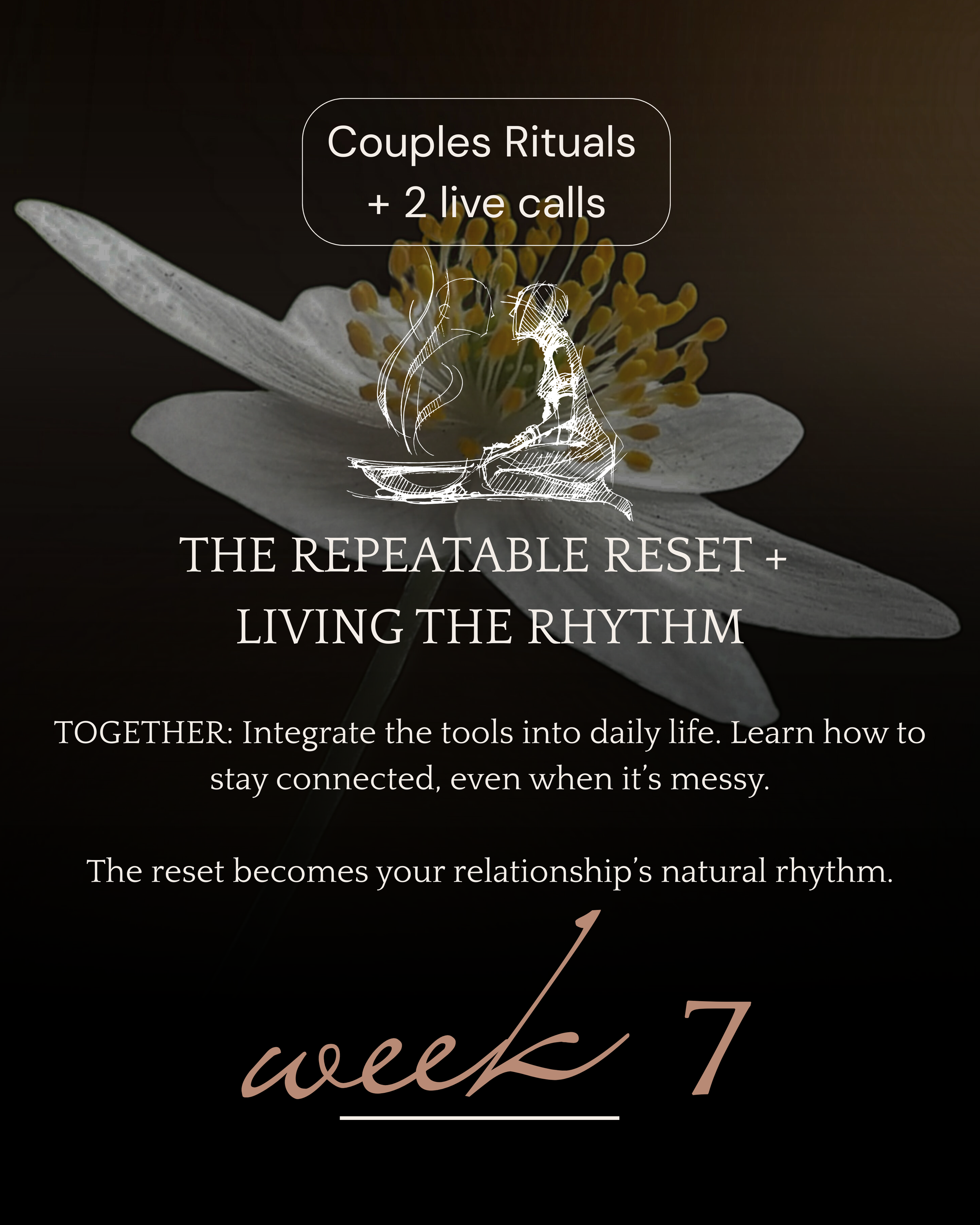
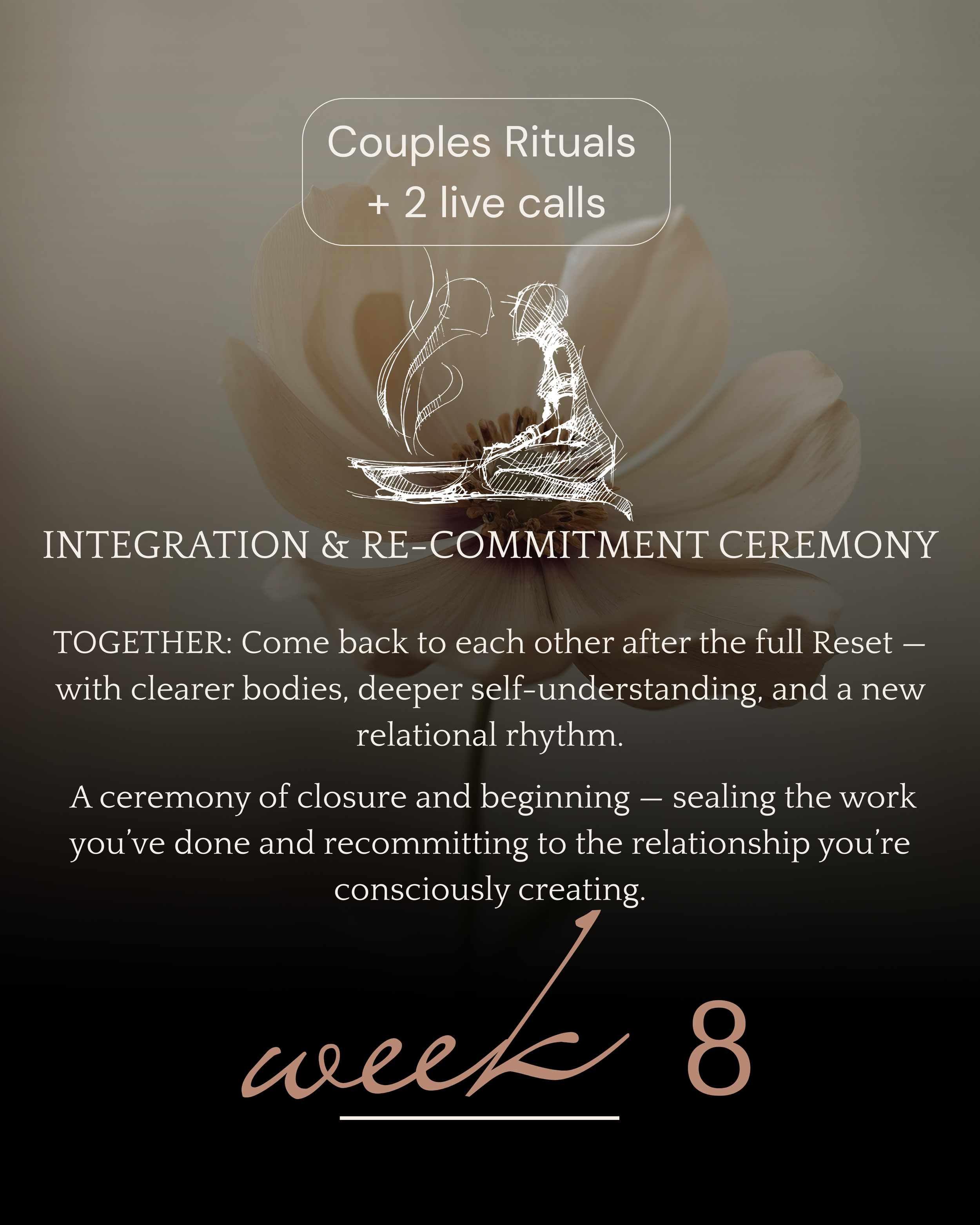
The Exact CurriculumThis is the precise map that transforms your relationship into the one your body dreamed of long before you had the language for it.
Live session schedule (Central Time)
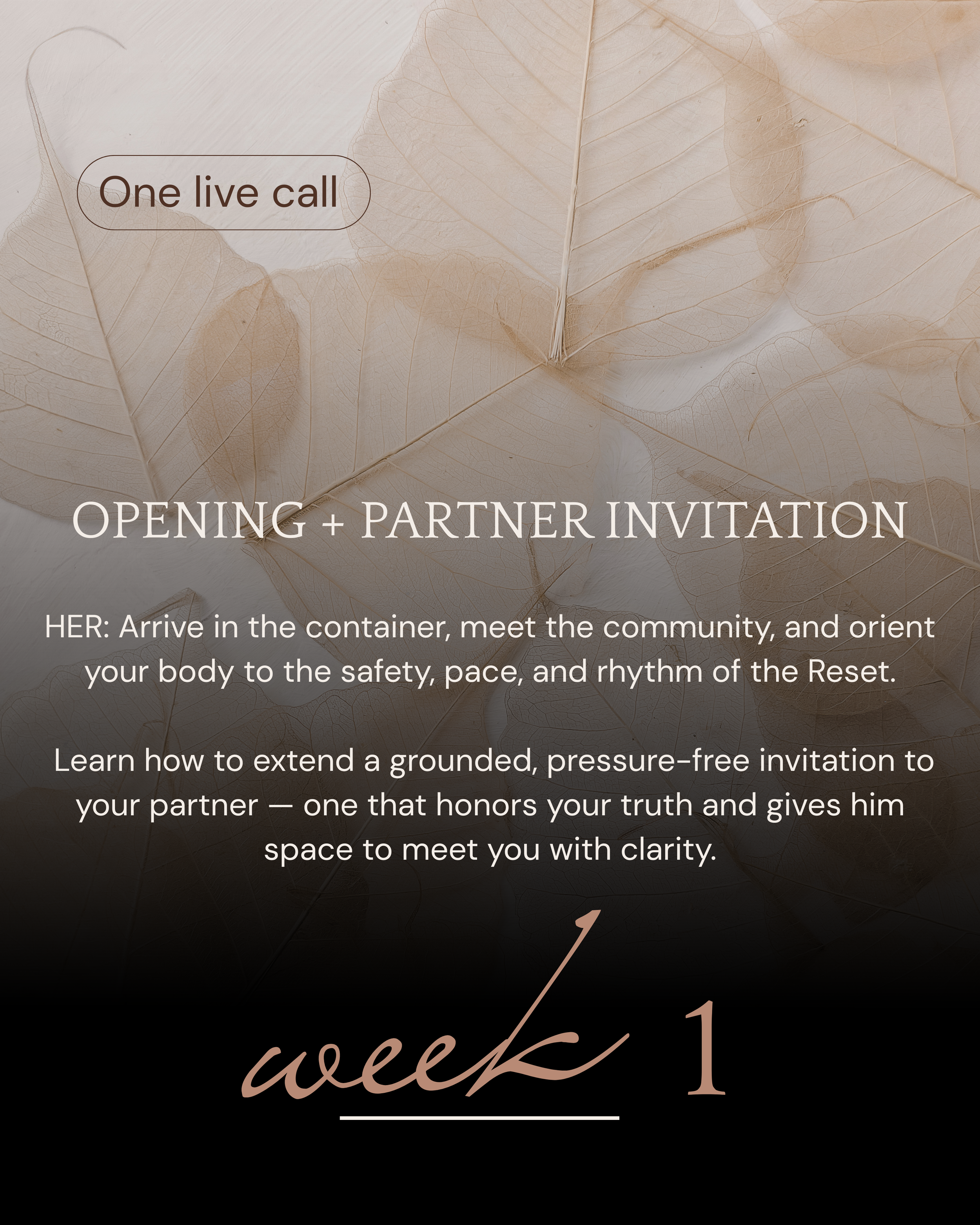
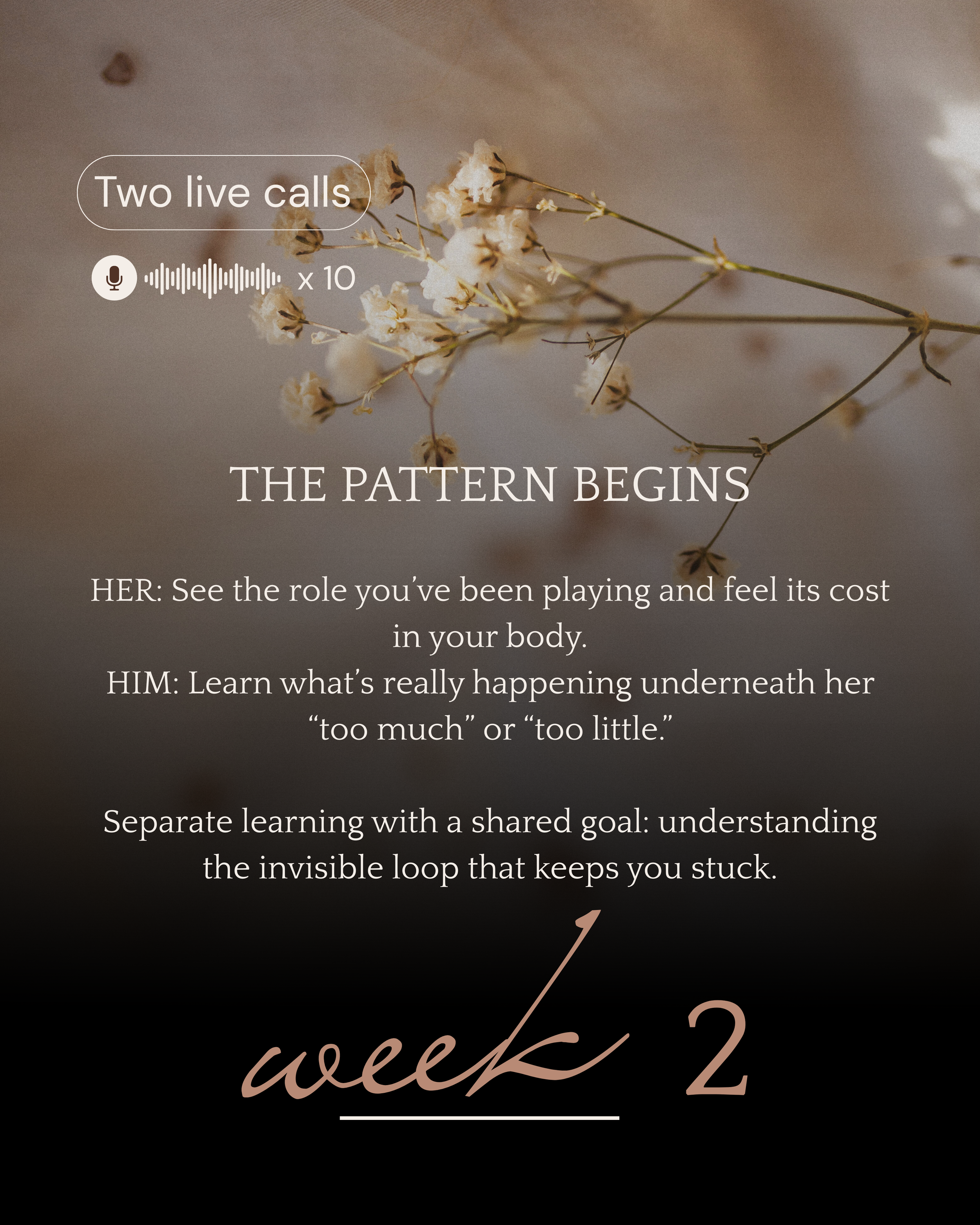
We meet for 8 weeks. Weeks 1–5 are separate tracks; Weeks 6–8 are as a couple.
Weeks 1–5 — Individual tracks
Mondays @ 6:30 PM CT — Women’s call
Feb 23, Mar 2, Mar 9, Mar 16, Mar 23
Wednesdays @ 6:30 PM CT — Men’s call (your partner’s slot)
Mar 4, Mar 11, Mar 18, Mar 25
Weeks 6–8 — Couples + optional practice space
Mondays @ 6:30 PM CT — Couples call
Mar 30, Apr 6, Apr 13
Wednesdays @ 6:30 PM CT — Optional practice space (lightly guided, drop-in)
Apr 1, Apr 8
Last Call: Apr 15 on Wednesday @ 6:30pm CT — Couples Integration + Re-Commitment Ritual
Can’t make one? Replays are provided inside the portal within 24 hours.
InvestmentMost couples spend years in therapy circling this dynamic.
Understanding it.
Talking about it.
Naming it.
And still living inside it.
Most women spend years trying to “communicate better.”
Hoping the right words will finally redistribute responsibility.
This is not that.
If you’ve been living inside this dynamic for years,
eight weeks will feel radical.
If you’re ready to stop managing the relationship,
this is where that begins..
Couplespay in full
One Payment of $1764
Couplespayment plan
4 payments of $444
Singlepay in full (women only)
One Payment of $1200
This could be the moment everything changes…
What people said while they were still inside the work:
“This will help you prioritize yourself and communicate better while handing off the problems of your partner to someone else. (Himself + coach.) After you both reset with self-responsibility, you’ll start working together to learn how to EFFECTIVELY co-regulate and so magically communicate. Become a stronger couple without abandoning yourself or letting him off the hook.”

Hey, I’m Nicole & This is why i absolutely had to create this course
I work specifically at the intersection of:
relational dynamics
nervous system regulation
and embodied er0t.ic patterning
I’m trained as a Certified S.e..xological Bodyworker and int1macy educator, and my work focuses on what happens after insight — when people understand the pattern, but their bodies and relationships haven’t reorganized yet.
This program was built by watching where other approaches consistently stall:
when responsibility quietly shifts onto one partner
when therapy becomes a place to talk about the relationship instead of changing how it’s lived
when attraction disappears not because of lack of love, but because of chronic role imbalance
RYER is not theoretical.
It’s the result of working with hundreds of individuals and couples inside this exact dynamic — and designing a structure that removes the need for one person to keep holding everything together.
A note on scope and integrity
This program does not replace therapy.
And it does not compete with it.
It exists because some relational patterns require structural interruption, not deeper understanding.
That’s the lane this work stays in — clearly, responsibly, and deliberately.
Frequently Asked Questions
-
That’s actually very common in this dynamic.
In emotional over-functioning patterns, one partner is usually more attuned to subtle shifts in connection. She notices tension sooner. She feels desire flatten earlier. She registers misalignment before it becomes visible.
The other partner often experiences the relationship as “fine” because the system is still functioning. Nothing is exploding. The bills are paid. You’re not fighting constantly. From the outside, it may even look stable.
But stability and aliveness are not the same thing.
If you’re feeling a persistent undercurrent — exhaustion, resentment, fading attraction, carrying more than your share — that’s information. It doesn’t mean you’re dramatic. And it doesn’t mean he’s failing.
It means the structure of the relationship may be organizing around one nervous system doing more of the work.
Reset Your E.r.o.tic Rhythm is designed for exactly this scenario. It doesn’t require him to already believe there’s a problem. It doesn’t rely on convincing or persuading.
It changes the pattern by changing roles — not by debating whether the pattern exists.
If you’re noticing it, that’s enough to begin.
-
No.
All relational work is inherently individual work.
You are the only nervous system you can directly change — and that alone can radically transform a relationship.You can absolutely do RYER on your own and still receive life-changing value:
Deep clarity about your patterns, needs, and limits
Relief from overfunctioning, managing, or self-abandoning
A felt shift in how you show up to conflict, intimacy, and desire
Stronger self-trust and discernment about what you want next
That said, RYER is designed to support couples when both partners are willing — because shared language, timing, and structure dramatically accelerate change together.
But participation is not a prerequisite for transformation.
Many people begin solo and later invite their partner once they feel grounded, clear, and resourced.You do not need permission to grow.
-
This is exactly why RYER includes a clear, respectful process for inviting a partner into the container — without pressure, convincing, or emotional over-explaining.
Rather than asking you to:
Pitch the program
Educate your partner
Argue for why this matters
Carry the emotional labor of “getting them on board”
RYER supports how the invitation happens.
You’ll be guided in:
Speaking from grounded self-clarity instead of urgency
Making an invitation that preserves dignity on both sides
Allowing your partner to meet the work at their own pace
Letting willingness emerge instead of being forced
Often, when one partner stops chasing change and starts embodying it, the relational field shifts — and curiosity follows.
And if your partner ultimately chooses not to join, the work you do inside RYER still stands.
Nothing is wasted. Nothing is contingent.You are not doing this to your partner.
You are doing it for yourself — and for the relationship as a whole. -
You’re likely ready if:
You don’t want to keep repeating the same fights
You still care, even if you’re exhausted
You sense there could be something more — but don’t know how to get there
You’re willing to be changed by the relationship, not just manage it
You do not need certainty.
You need willingness.
-
You can reach us anytime via our contact page or email. We aim to respond quickly—usually within one busiRYER is facilitated by Nicole Siegel, Certified Sexological Bodyworker® and founder of Body Compass.
This work draws from:
Somatic education
Nervous system regulation
Attachment-aware relational frameworks
Generational and cultural patterning
Erotic embodiment practices
It is not rooted in pop-psychology or quick-fix coaching.ness day.
-
No. RYER is not psychotherapy, couples counseling, or mental health treatment.
RYER is an educational and somatic learning experience focused on relational patterns, nervous system awareness, emotional maturity, erotic aliveness, and conscious partnership.
While many people experience healing, insight, and emotional release, this program does not diagnose, treat, or replace therapy.
If you are currently in crisis, experiencing abuse, or dealing with unmanaged mental health conditions, RYER may not be appropriate without additional professional support. -
No. Many participants continue individual therapy or personal growth work alongside RYER.
Think of this as relational infrastructure — the place where insight becomes lived experience together.
-
Because of the nature of digital content, group calls, and immediate access to materials, all sales are final.
Please read the program description carefully and reach out with questions before enrolling. This container is designed for couples who are ready to engage — not to sample.
-
Yes.
Group spaces are confidential.
Participants agree not to share personal stories or identifying details outside the container.That said, this is a group experience — absolute anonymity cannot be guaranteed. Please participate at the level that feels safe and aligned for you.
-
Outcomes vary, but participants commonly report:
More spacious, less reactive conversations
A decrease in chronic conflict loops
Increased emotional safety
Renewed erotic curiosity and intimacy
Clearer boundaries and self-trust
A felt sense of being on the same team again
There are no guarantees — because relationships involve two autonomous humans — but this container is designed to make real change possible.
-
RYER is designed primarily for couples in long-term partnership and speaks often to heterosexual dynamics because of cultural conditioning — but the underlying principles apply across genders and orientations.
All participants are expected to engage respectfully.
-
No.
While er0ticism, desire, and s3xuality are discussed, no explicit s3xual acts, nudity, or touch are required at any point.
All practices are optional, invitational, and grounded in consent.
-
No — and this matters deeply.
RYER does not pathologize men, shame masculinity, or frame relationships as a polarity problem where one person is “too much” and the other is “not enough.”
This work:
Holds men with dignity and accountability
Names cultural and generational conditioning without blame
Supports emotional development without feminizing or shaming
Centers mutual empathy, not hierarchy
Many men experience this program as relieving, clarifying, and deeply stabilizing.
what it looks like when you’re no longer carrying this
alone...Just Imagine…You wake up feeling yourself.
Not bracing. Not tiptoeing around a partner’s fragility.
Just grounded, juicy, steady in your own rhythm.
You stretch—slowly—because your nervous system isn’t in flight mode anymore.
You remember last night’s touch: delicious, mutual, unforced.
You didn’t perform. You didn’t explain.
You just opened.
Because he finally knew how to meet you. And that’s what makes you want him again.